SEEC Members Highlight Strategies to Build a Thriving Economy
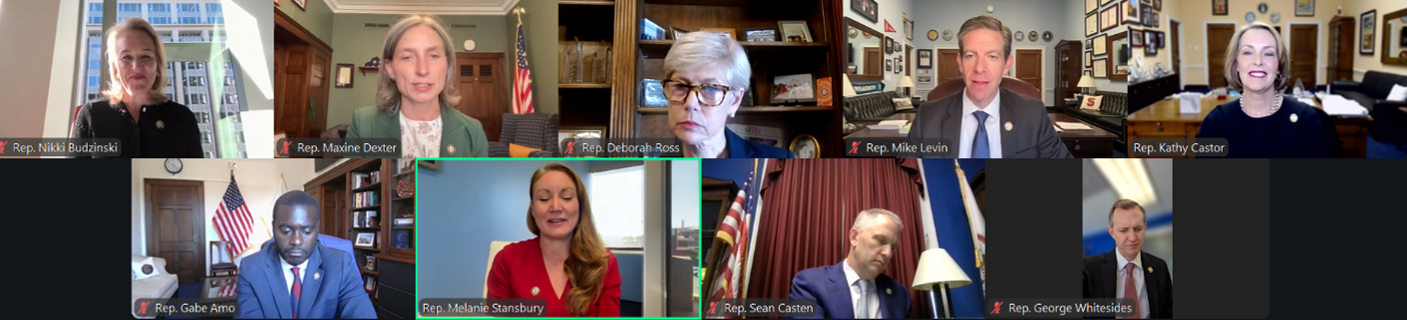
Washington, D.C. – Today, members of the House Sustainable Energy and Environment Coalition (SEEC), including Vice Chairs Reps. Sean Casten (IL-06) and Mike Levin (CA-49), as well as Members Reps. Nikki Budzinski (IL-13), Kathy Castor (FL-14), Maxine Dexter (OR-03), Deborah Ross (NC-02), Melanie Stansbury (NM-01), and George Whitesides (CA-27), participated in a press conference to highlight the more than 800 policy ideas in the newly released Thriving Economy Project report that will address the unique set of challenges facing American families and businesses today and help usher in a cleaner, safer, and thriving American economy.
“My district is one of the most productive farmland areas in the country. And while the reality is that while our farmers are producing more than ever, too many are struggling to stay in business. The time is now for a federal policy framework that reflects the realities of modern agriculture,” said Congresswoman Nikki Budzinski. “That's what the Thriving Economy Project is all about -- making sure the next generation has a real opportunity to farm, own land, and build a successful business. This is just one glimpse into the policy proposals we’ve put out in this project. I’m excited that once Democrats take back the House, we can begin to take real action. And this project gives us the tools we need to make that happen.”
“The chapter on Thriving, Affordable, and Resilient Communities is deeply personal to me as Tampa Bay’s Congresswoman. Since 2020, Tampa has had 136 record-high temperatures and one record-low. That means higher electric bills for families running their AC, more dangerous conditions for our farm workers, and more people in the hospital,” said Congresswoman Kathy Castor. “The Thriving, Affordable, Resilient Communities chapter offers a practical agenda to meet those challenges head-on. It focuses on aligning federal tools with local leadership – supporting safer housing, smarter infrastructure, lower energy costs, and stronger main streets. Thriving communities are the foundation of a strong American economy – and we’re providing a roadmap to help every family, in every zip code, share in a healthier and more secure future."
“The scale of capital that we need to address the climate crisis – from wildfires, to flooding, to the spread of tropical diseases, crop failures, and on and on down the list – that amount of money vastly exceeds the capacity of the federal government,” said Congressman Sean Casten. “What we really tried to address is, number one, to recognize that 25% of the U.S. economy is federal spending and 75% is not. We asked all our contributors to not limit your solution space to simply tax and spending policy for the federal government. How do we make sure that we unlock the capital in all of those climate change mitigating strategies, so that we can lever the private sector and bring that capital into all the other needs that we have.”
“We have just come through the worst wildfire season ever on record in Oregon, with over two and a half million acres burned. And what I have learned in the last month is that every time we have these events, we are not just under-prepared for them, but we are under-acknowledging the impacts on our communities, the impact of smoke on children, on our elders, on our infrastructure, and our agriculture,” said Congresswoman Maxine Dexter. “This chapter is especially dear to my heart because of the benchmarks that we are centering on. Number one, that public health is strengthened through guaranteed access to clean air and clean water. As a mother, as a pulmonary and critical care doctor who has been practicing for 20 years, I can tell you that clean air is not just a human right; it is something that is foundational to our thriving economies.”
“Right now, energy bills are rising faster than households can manage as America suffers through an energy affordability crisis that is forcing families to choose between paying for their electric bill or paying for other essentials like rent or groceries. Nationwide, roughly 17 percent of Americans are struggling to keep up with their electric bills, and energy costs are rising faster than inflation. It is clear from these skyrocketing costs that our current approach to energy policy simply is not working. The American people deserve better,” said Congressman Mike Levin. “This chapter, Chapter Five, provides solutions to our energy affordability crisis and lays out how we can modernize our electric sector to ensure that families can afford their bills and we can energize the industries of the future. Our proposed solutions and policy recommendations are all rooted in one central premise: Working families must be the focus of any plan for a thriving economy and that begins by addressing energy affordability.”
“In my home state of North Carolina, we know just how urgent the work is. We’ve seen the devastating impact of extreme weather across our state, from homes falling into the ocean as sea levels rise along the Outer Banks, to record-breaking heat scorching rural farmland, to widespread devastation from Hurricane Helene and the landslides that follow,” said Congresswoman Deborah Ross. “In light of these tragedies, it makes what this project achieves remarkable. It addresses the environmental and infrastructure problems facing us today, while also building a roadmap for the future. Our country’s energy industry is at an inflection point. That is why it’s so important for the Thriving Economy Project’s chapter on next generation energy technology to make sure that it is researched, developed, and built in the United States.”
“Right now, New Mexico is experiencing the most sustained drought that we have experienced in modern recorded history. And when you think about the long history of communities like those that I represent, not only is water life, water is sustaining, water is culture, water is necessary for thriving economies,” said Congresswoman Melanie Stansbury. “And that is really at the heart of this effort, which is how do we put together a policy proposal for the future of the United States that revitalizes our commitment as a nation to our rural and tribal communities and all of our diverse communities that each of us represent across the United States. I believe that we are on the precipice of a new New Deal for America.”
“We must confront a fundamental and important reality: that is an energy policy that’s reliant on fossil fuels, even those produced in the United States, places Americans at risk of wild price swings. Transitioning to domestic, clean energy reduces our and our allies’ dependence on global geopolitical choke points. It is also a critical step in reducing the risk my and many other districts face from severe wildfires and other disasters associated with climate change,” said Congressman George Whitesides. “We are reminded daily of our vulnerability to global energy stocks and shocks. If we make the right investments and policy choices, we can build an energy system that is more resilient to wildfires and other disasters, more affordable, and less dependent on adversarial nations.”